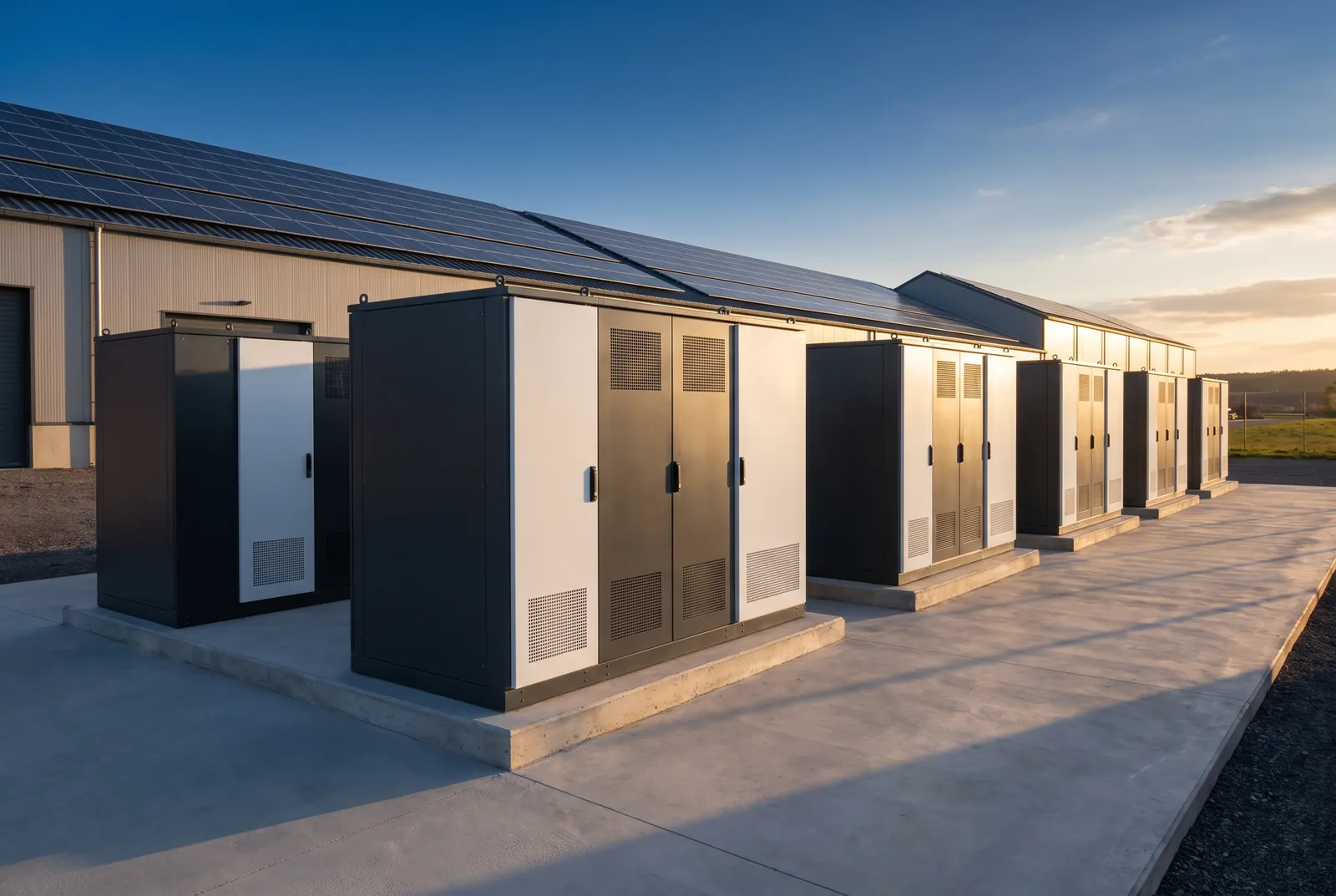
Commercial Battery Storage · Southern California
Commercial Battery Storage: Store Power. Control Costs.
Commercial battery energy storage for Los Angeles and Southern California businesses turns your energy bill from a fixed burden into something you actively manage, and keeps your operation running when the grid does not.
Why Storage
Three Jobs, One System
A commercial battery earns its keep in three distinct ways, stacking value across every hour of the day.
Cut Demand Charges
Demand charges bill you for your single highest 15-minute spike of the month and can dominate a commercial bill. Batteries shave those peaks automatically, month after month.
Beat Time-of-Use Rates
Charge the battery from your solar or from cheap off-peak power, then run on stored energy when rates spike in the evening window. Arbitrage, fully automated.
Ride Through Outages
Wildfire seasons, public safety shutoffs, and grid strain are the new normal. Storage keeps refrigeration, servers, security, and critical operations online.
Solar + Storage
Better Together
Pairing storage with solar multiplies the value of both. Under SCE's Net Billing Tariff, exported solar is credited at time-varying rates that are lowest exactly when solar produces most. A battery lets you hold that energy and use or export it when it is worth the most.
In LADWP territory, the FiT+ program was created specifically for paired solar plus storage projects, extending the feed-in tariff model into dispatchable clean energy.
- Higher self-consumption: use your own solar instead of selling it low and buying it back high
- Export timing: discharge to the grid when credits peak
- Resilience included: the same battery backs up your critical loads
Incentives
Storage Is Where the Incentives Live Now
Federal law tightened solar timelines in 2025 but left battery storage on a longer, richer track.
Federal ITC Through 2033
Energy storage retains its full federal investment tax credit for projects beginning construction through 2033, then phases down (75% in 2034, 50% in 2035). Solar's compressed deadlines do not apply to storage.
California SGIP
The Self-Generation Incentive Program offers rebates for commercial storage, currently $250 per kWh for qualifying large-scale systems, subject to funding availability by budget category.
Full Expensing
Qualifying storage assets acquired and placed in service after January 19, 2025 are eligible for 100% bonus depreciation, letting owners expense the system in year one.
Incentive summaries only, not tax advice. Program terms change; we confirm current rules for your specific project during assessment.

Code Compliance
New Buildings Now Require Storage
California's 2025 Title 24 energy code, effective January 1, 2026, requires most new nonresidential buildings to install both solar and battery storage, with system sizes driven by roof area and building type. If you are planning new construction, storage is no longer optional, and designing it well is the difference between a compliance cost and a performing asset.
Title 24 requirementsGood Fit Check
Is Storage Right for Your Facility?
My demand charges are high. Will a battery actually help?
Usually, yes. We analyze a full year of your 15-minute interval data to see how sharp and predictable your peaks are. Sharp, short spikes are ideal for batteries; we size the system to clip them and model the savings before you commit to anything.
Do I need solar to add storage?
No. Standalone storage qualifies for the federal credit on its own timeline and can deliver demand charge savings without any solar. That said, pairing with solar usually improves both systems' economics, especially under today's export rules.
How much backup do I get during an outage?
That depends on what you choose to back up. Most commercial designs protect critical circuits such as refrigeration, IT, security, and life safety rather than the whole building, which keeps the battery affordable while covering what matters. Paired with solar, backup can extend indefinitely for the covered loads.
What about safety and permitting?
Modern commercial systems use UL-listed equipment with integrated fire detection and suppression provisions, and they are permitted under well-established codes. Our team handles the full approval path, including utility interconnection.
Find Out What a Battery Would Save You
Send us a recent bill and we will model your demand charge savings, incentive stack, and backup coverage. Free, and the numbers are yours to keep.