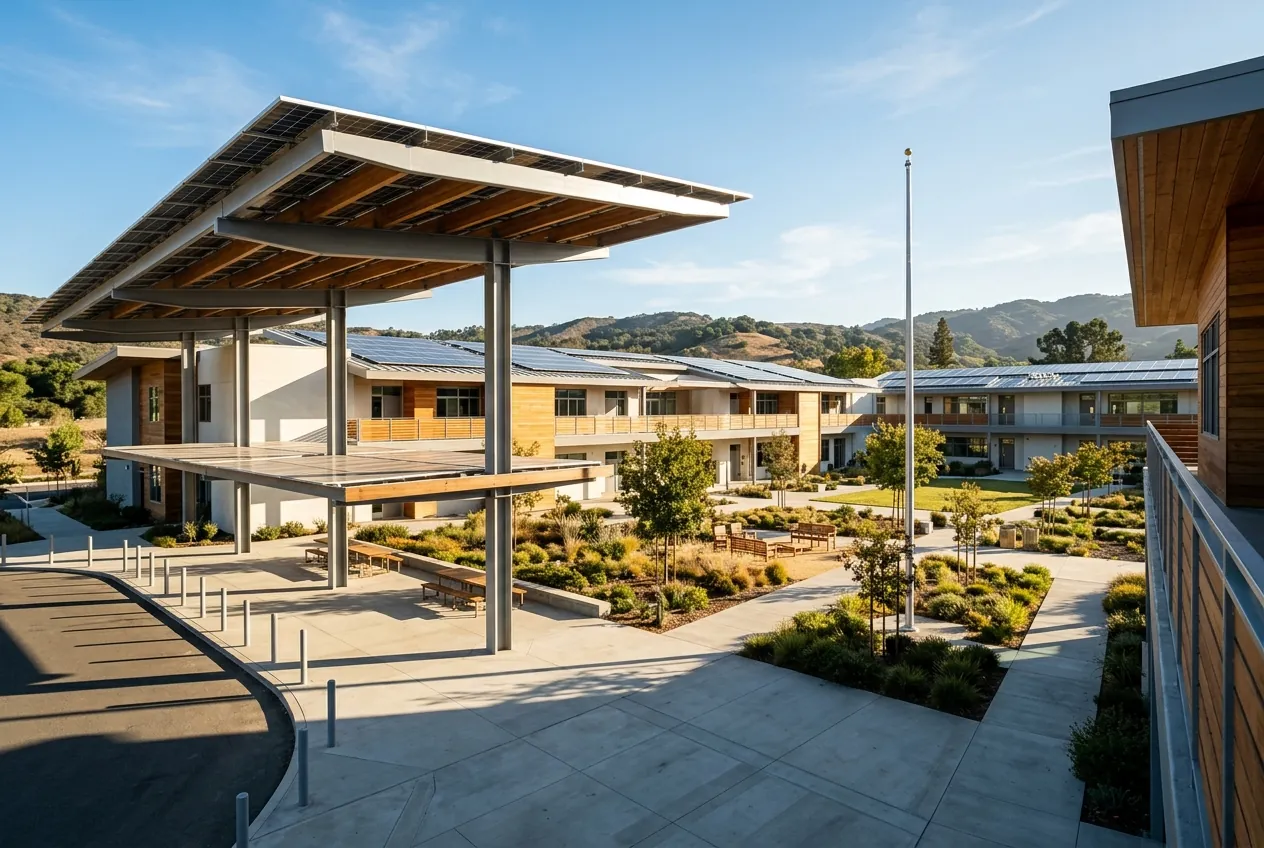
Solar for Specialty and Institutional Construction
Some buildings fit no standard category, and the 2025 Energy Code brought several of them, including religious worship and sports and recreation, under the solar and storage requirements for the first time. Eventure plans solar for specialty and institutional projects with the same early-involvement discipline we bring to every building type.
Applicability varies widely across specialty buildings. Libraries, offices, and assembly spaces have long been listed occupancies; the 2025 code added religious worship, sports and recreation, and events and exhibits. Many agricultural and unconditioned storage structures fall outside the requirement. Each building is classified during design.
Self-storage buildings have big roofs and small electric bills, which makes them a different kind of solar project. Whether the Energy Code requires solar depends on whether the storage is climate controlled, and whether the array makes sense beyond the code depends on how exported power is valued in the facility's utility territory.
Conditioned or not. Climate-controlled storage is conditioned space and is evaluated like a conditioned warehouse. Unconditioned storage buildings are not subject to the PV and storage requirements.
Agricultural operations pair high seasonal loads, irrigation pumping, refrigeration, and processing, with land that can host ground-mounted arrays. Many agricultural structures sit outside the Energy Code's PV requirements, so the decision is usually economic: what the operation pays for power and how the utility values what the array produces.
Ground mounts and land use. Ground-mounted arrays on marginal land or adjacent to facilities often provide the best capacity. Land use approvals and agricultural preservation rules are checked early.
A winery is a food processing plant that hosts guests. Production loads peak at harvest with crush, refrigeration, and tank cooling, while tasting rooms and hospitality spaces run on a very different schedule. The architecture is often part of the brand, which makes equipment placement and array aesthetics design decisions rather than technical ones.
Harvest peaks. Crush and fermentation cooling create a sharp seasonal peak. Storage and sizing strategy reflect that calendar.
Public buildings carry public expectations: sustainability targets, resilience for essential services, transparent procurement, and prevailing wage. The Energy Code requires solar and storage on most new civic buildings, and agencies typically design beyond the minimum to support emergency operations and climate commitments.
Procurement and delivery method. Design-bid-build, design-build, and lease-leaseback deliveries each place the solar scope differently. We adapt to the agency's method and documentation requirements.
The 2025 Energy Code added religious worship to the occupancies that must install PV and battery storage, so new sanctuaries, temples, and worship centers permitted on or after January 1, 2026 carry the requirement. Many congregations were already pursuing solar for stewardship and operating cost reasons; the code now sets the floor.
New occupancy under the 2025 code. Religious worship buildings permitted on or after January 1, 2026 fall under Section 140.10. Projects permitted earlier may not have carried the requirement.
Community centers are increasingly designed as resilience hubs: places where residents can cool off, charge devices, and find information during heat events and outages. Solar and storage make that role real, and the Energy Code now requires both on the assembly and recreation occupancies these buildings contain.
Resilience hub design. Storage sized to carry cooling, lighting, refrigeration, and communications through outages turns a community center into a resilience hub. That is a design-phase decision.
Sports complexes, aquatic centers, and recreation facilities carry lighting, pool heating, and HVAC loads that run into the evening, and the 2025 Energy Code added sports and recreation to the occupancies that must install PV and battery storage. Large roofs, parking fields, and spectator canopies give these facilities more solar area than most.
Evening loads. Field lighting and evening programming fall outside solar hours. Storage shifts daytime production into those windows and reduces demand charges.
Licensed indoor cultivation facilities carry some of the highest electrical loads per square foot of any building type, driven by horticultural lighting and dehumidification. Solar cannot carry that load alone, but it offsets a meaningful share, storage attacks the demand charges, and many local jurisdictions now expect renewable energy in the permit application.
Load reality. Horticultural lighting and HVAC loads far exceed what a roof produces. We present the offset honestly and design storage for demand management.
Planning a specialty & institutional project in California?
Send us the drawings at any stage. We will size the requirement, review the roof and electrical approach, and map the path to a Certificate of Occupancy that does not wait on solar.