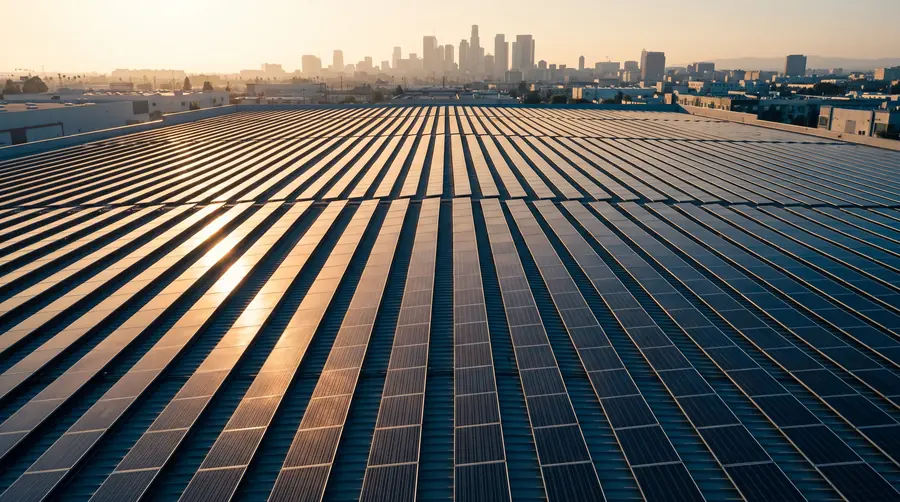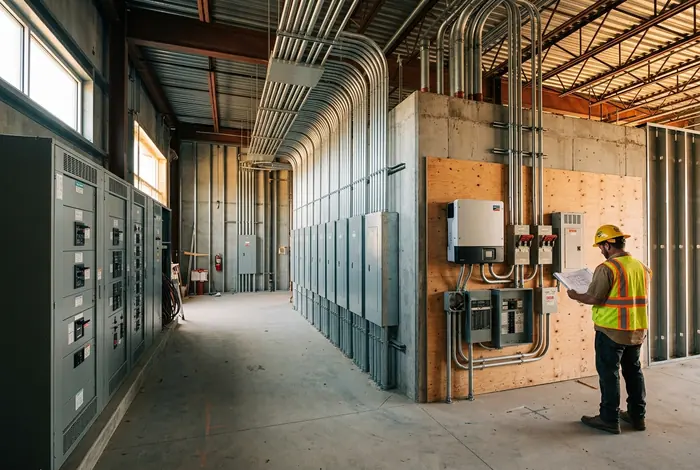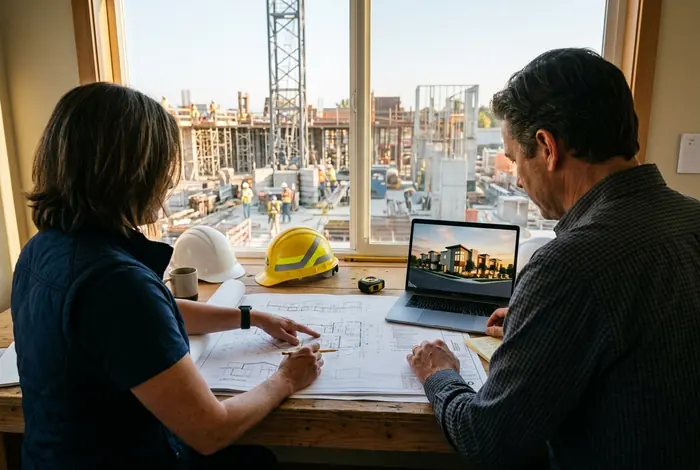
When Should Solar Be Designed Into a New Construction Project?
Schematic design. Every phase after that narrows the options and raises the cost of the same decisions.
Guide
Most new nonresidential buildings and all high-rise multifamily buildings that require PV also require a battery. Here is how the requirement works.
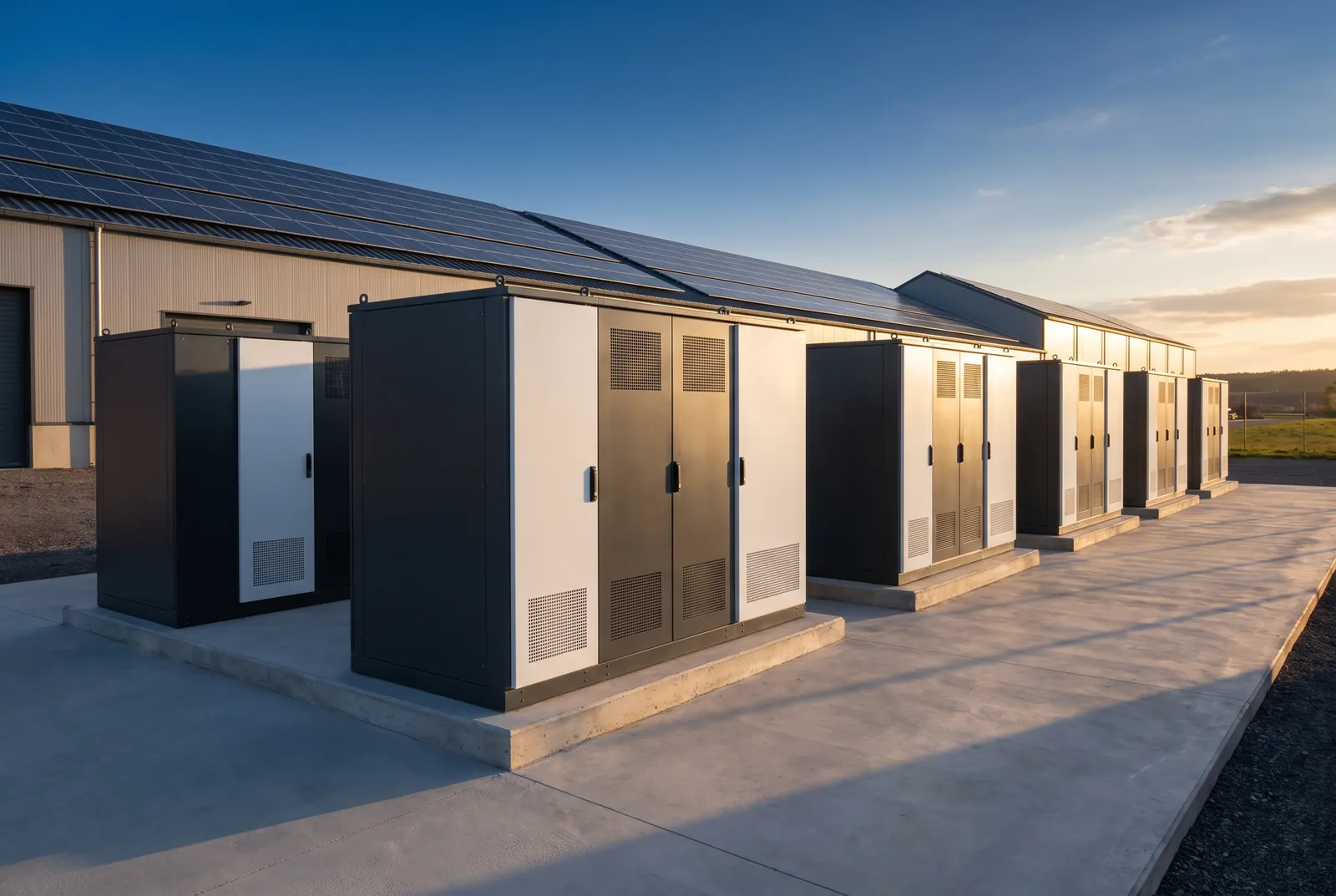
The battery requirement is the part of the Energy Code that surprises project teams most. Solar on the roof has been expected for years; a battery system with its own room, clearances, and fire review is newer, and it is the item most often left without a home until late in construction.
Nonresidential buildings. Under Section 140.10(b), newly constructed nonresidential buildings that are required to install a PV system must also install a battery energy storage system. The listed occupancies include office, retail, grocery, school, warehouse, hotel/motel, restaurant, medical office/clinic, library, auditorium, convention center, and theater, and under the 2025 code, events and exhibits, religious worship, and sports and recreation. The 2025 code removed the battery requirement for schools, offices, financial institutions, unleased tenant spaces, and medical offices in Climate Zone 1.
High-rise multifamily. Under Section 170.2(h), newly constructed multifamily buildings of four or more habitable stories that are required to install PV must also install a battery. Exceptions apply where the installed PV is below 15% of the calculated size or the required battery would be under 10 kWh.
Low-rise multifamily and single-family. A battery is not required, but a qualifying battery can reduce the required PV size. For low-rise multifamily, a battery of at least 7.5 kWh meeting JA12 allows a 25% reduction in required PV.
Battery capacity is derived from the PV system size. The Energy Code multiplies the PV capacity by an energy capacity factor for the building type, adjusted for round-trip efficiency, to set the minimum rated energy capacity, and by a power capacity factor to set the minimum rated power. The 2025 Energy Code updated the equations (140.10-B, -C, and -D for nonresidential) and revised the capacity factors for all building types. In mixed-occupancy buildings, the requirement is calculated per occupancy and summed.
Batteries must be certified to the Energy Commission under Reference Joint Appendix JA12, which sets requirements for safety, minimum performance, and control strategies. Under JA12, systems must provide usable capacity above 5 kWh, achieve round-trip efficiency above 80% for prescriptive compliance, and retain 70% of nameplate capacity after 4,000 cycles or under a 10-year warranty. Controls must be capable of the operating modes the code specifies.
This is the design problem. A code-compliant battery location needs clearances from doors, windows, and other equipment, ventilation or thermal management appropriate to the chemistry, signage, and access for the fire department. The fire code and the fire authority's own standards govern the installation, and they review it. A location chosen in design development with those requirements in hand passes review. A location found during construction is negotiated.
Battery systems and the switchgear they connect to carry lead times. The fire authority's review adds a step to plan check. Electrical and fire inspections of the battery must close before the building's final. Each of these is manageable when the battery is designed in and scheduled; each is a delay when it is not.
A compliance battery can be a resilience battery if the critical-load panel and controls are in the electrical design. Many owners size storage beyond the minimum to carry life-safety, refrigeration, communications, or elevator loads through outages, or to reduce demand charges. The incremental cost during design is modest; the retrofit cost later is not.
Newly constructed nonresidential buildings required to install PV under Section 140.10 must also install battery storage, with limited exceptions. Buildings that are exempt from the PV requirement, including unconditioned warehouses and buildings with very limited solar-accessible roof area, are not required to add storage.
It is calculated from the PV system size using building-type energy and power capacity factors. The 2025 Energy Code updated the equations and factors. We prepare the calculation during schematic design with the project's energy consultant.
Yes, if the critical-load panel, transfer equipment, and controls are designed for it. The code sets a minimum capacity; the owner decides whether the system also serves resilience.
Keep Reading
Schematic design. Every phase after that narrows the options and raises the cost of the same decisions.
The building's final inspection depends on the Energy Code scope being complete and documented. If solar is the last trade on site, solar is the delay.
Twelve mistakes we see on California projects, why they happen, and what the fix looks like on paper.