When Should Solar Be Designed Into a New Construction Project?
Schematic design. Every phase after that narrows the options and raises the cost of the same decisions.
Utility Programs
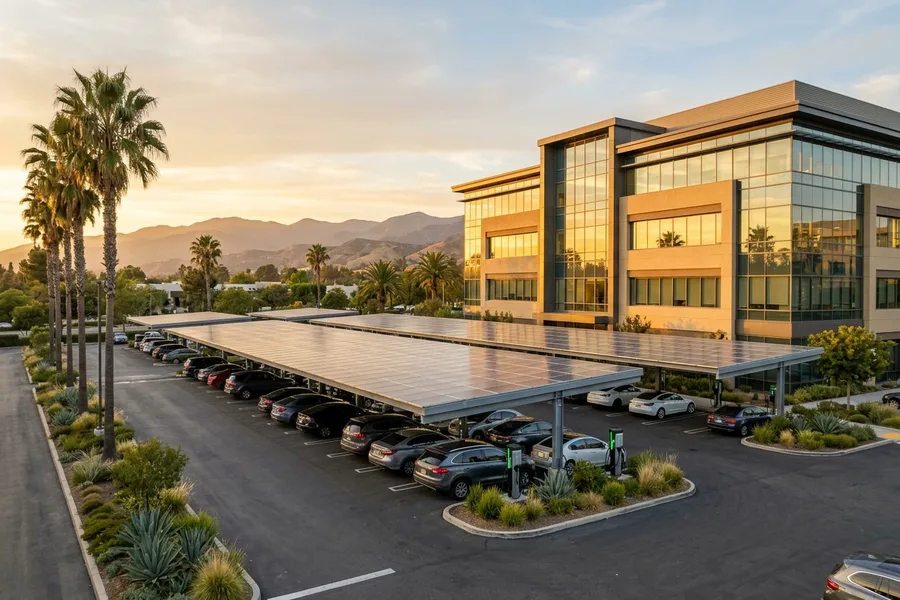
Los Angeles property owners have an option most of California does not: LADWP will buy solar power directly from them under long-term contracts. Three LADWP programs work together here, the Feed-in Tariff (FiT), the newer solar plus storage pilot called FiT+, and a one-time incentive for solar built on carports and canopies. For a parking lot or a large roof that produces more than the building can use, they can turn idle space into a steady line of income.
FiT is a sell-all arrangement. The owner or a developer builds a system of at least 30 kW, and LADWP buys every kilowatt-hour it produces under a Standard Offer Power Purchase Agreement of up to 20 years, or 10 years with optional one-year extensions. The power is not used on site: a project that consumes more than 10% of its own output over a year is moved off FiT, and net-metered systems serving the building do not qualify. In-basin solar currently earns 14.5 cents per kWh for 30 to 500 kW, 14.0 cents up to 3 MW, and 13.5 cents above that, as we covered in our earlier post on LADWP's 2026 rates. At 14.5 cents, every 100,000 kWh delivered is $14,500 of contracted revenue. LADWP reported 58.8 MW of program capacity still available as of November 2, 2026, allocated first come, first served.
For FiT projects built over parking, LADWP adds a one-time payment on top of the energy price, based on the carport or canopy capacity. The rate is $1.50 per watt for projects under 500 kW, $1.20 per watt from 500 kW to 3 MW, and $0.90 per watt from 3 MW to 10 MW, with higher amounts of $1.70, $1.40, and $1.10 per watt in state-designated disadvantaged communities. On a 300 kW canopy outside those communities, that is $450,000 paid after the project reaches commercial operation. The incentive is offered when LADWP opens funding and is awarded by queue position, carport projects must include EV charging for a share of the spaces, and the payment must be returned if the system comes down within 10 years. The canopy also shades the lot, which tenants notice every summer.
FiT+ pairs solar with a battery and pays more for energy delivered when the grid needs it. Applicants bid a base price, and LADWP multiplies it by 2.0 during winter and spring peak hours, typically 5 to 10 p.m., and by 3.0 during summer and fall peak hours, with the annual average capped at $250 per MWh. Projects must deliver at least 25% of their energy during peak hours, sign a 20-year contract, and sit on an eligible LADWP circuit, and LADWP reimburses part of the interconnection cost after the project comes online. The pilot totals 35 MW, and its Tranche A application window runs from October 12, 2026 to January 10, 2027. FiT+ projects cannot also take other LADWP incentives, including the carport payment, so owners should model both paths.
FiT suits owners who want simple, contracted income from a lot or roof without changing how the building buys power. The carport incentive improves the return on parking structures that would otherwise sit unshaded. FiT+ rewards owners and developers willing to add storage in exchange for higher evening value. Each requires hard copy applications by mail, development experience on the team, and site control, so the paperwork deserves early attention.
In Los Angeles, a parking lot can earn money twice: once from LADWP for every kilowatt-hour, and once from a canopy incentive that pays a large share of the structure. Run the numbers for FiT, the carport incentive, and FiT+ side by side before deciding, because the best choice depends on the site, the circuit, and how long you plan to hold the property.
Program prices, incentives, and capacity cited here reflect our reading of LADWP's published program pages and guidelines as of the date above; terms change and funding opens and closes, and we verify them for every engagement.
Keep Reading
Schematic design. Every phase after that narrows the options and raises the cost of the same decisions.
The building's final inspection depends on the Energy Code scope being complete and documented. If solar is the last trade on site, solar is the delay.
Twelve mistakes we see on California projects, why they happen, and what the fix looks like on paper.