When Should Solar Be Designed Into a New Construction Project?
Schematic design. Every phase after that narrows the options and raises the cost of the same decisions.
Title 24 Guide
Since 2023, most new commercial buildings in California must install solar and a battery. The 2025 code expanded the list and raised several capacity factors.
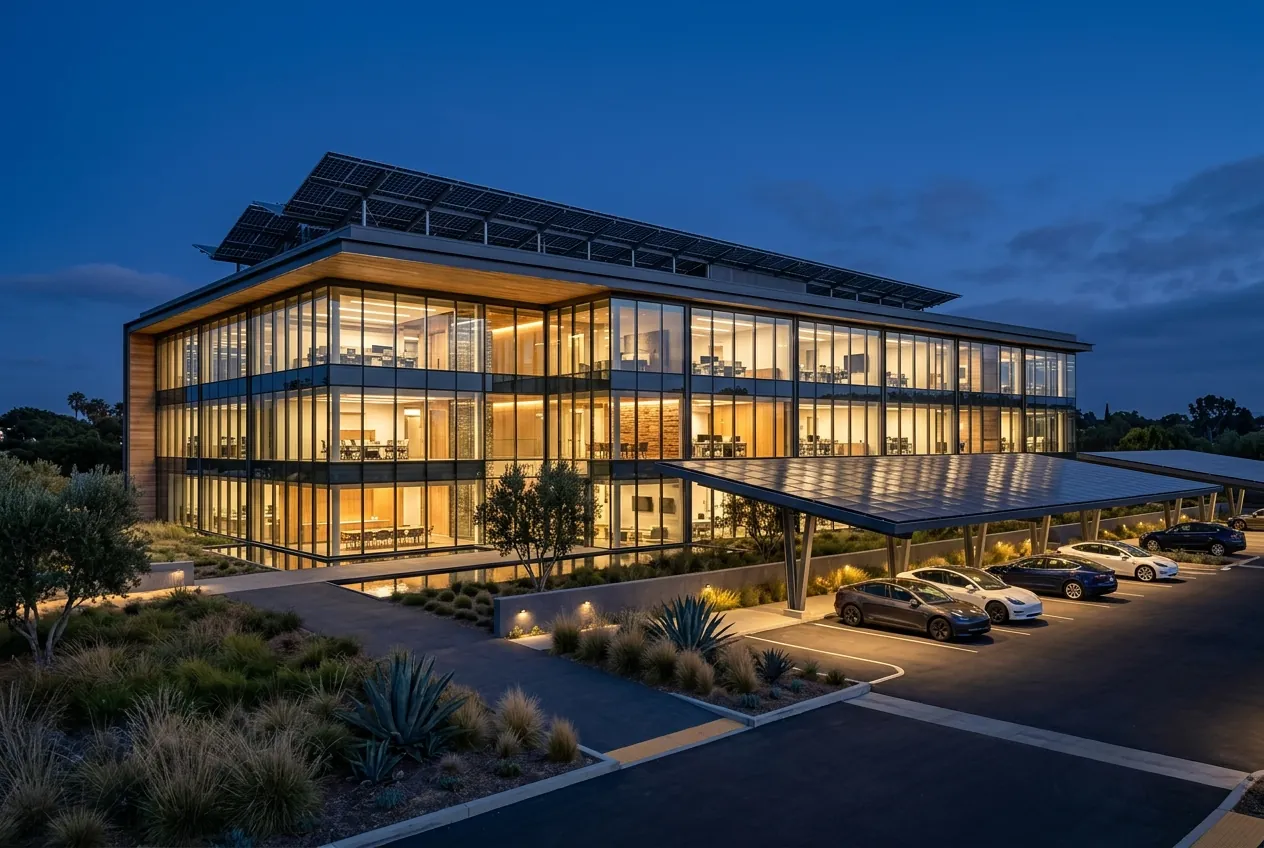
Section 140.10 of the California Energy Code is the prescriptive requirement for photovoltaic and battery storage systems on new nonresidential buildings. It has applied since January 1, 2023, and the 2025 code carries it forward with changes that matter for several building types. The summary below reflects published Energy Commission materials; the project's energy consultant and the authority having jurisdiction determine the final requirements.
The requirements apply to newly constructed buildings where at least 80% of the total floor area, conditioned or not, is in the building types listed in Table 140.10-A: grocery, high-rise multifamily, office, financial institutions, unleased tenant space, retail, school, warehouse, auditorium, convention center, hotel/motel, library, medical office building/clinic, restaurant, and theater. The 2025 code adds events and exhibits, religious worship, and sports and recreation. Mixed-occupancy buildings qualify when the listed types together reach 80%.
The requirements do not apply to additions or alterations, or to unconditioned buildings, with one important exception: first-time tenant improvements in unoccupied, previously unused space are subject to the PV and storage requirements. Unconditioned warehouses are not required to install PV or storage; conditioned warehouses are.
The required PV capacity is the smaller of two results. The first is Equation 140.10-A, which multiplies conditioned floor area by a capacity factor from Table 140.10-A for the building type and climate zone. The second is the Solar Access Roof Area multiplied by 14 watts per square foot for low-slope roofs and, under the 2025 code, 18 watts per square foot for steep-slope roofs, with mixed roof types summed. Mixed-use buildings calculate each building type, including support areas, and add the results.
SARA includes roofs, covered parking, carports, and new structures capable of supporting PV, and excludes areas with less than 70% annual solar access, areas the building code requires to be kept clear, and areas unavailable for other code reasons. PV may be installed on the SARA, on the ground on the property, or on a carport on the lot.
Buildings required to install PV must also install a battery storage system unless an exception applies. Capacity is calculated from the PV size using energy and power capacity factors from Table 140.10-B; the 2025 code updated Equations 140.10-B, -C, and -D and revised the factors for all building types. Under the 2025 code, schools, offices, financial institutions, unleased tenant spaces, and medical office buildings and clinics in Climate Zone 1 do not require a battery. Batteries must meet Joint Appendix JA12.
Newly constructed nonresidential buildings up to three habitable stories (excluding certain institutional occupancies), hotels and motels up to 10 habitable stories, and additions that add at least 2,000 square feet of roof area must meet solar-ready requirements when they are not required to install PV.
Under the performance approach, the proposed design must meet the Source, Efficiency, and Total energy budgets of the standard design. Greater building efficiency can reduce the required PV size. Community solar may be an alternative where the Energy Commission has approved a program for the building type and area.
The 2025 Energy Code applies to buildings whose permit applications are filed on or after January 1, 2026. Projects permitted earlier remain under the 2022 code. Permit timing on the margin changes required system sizes and budgets, and should be planned deliberately.
Newly constructed nonresidential buildings where at least 80% of floor area is in listed occupancies: grocery, office, financial institutions, unleased tenant space, retail, school, warehouse, auditorium, convention center, hotel/motel, library, medical office/clinic, restaurant, theater, and under the 2025 code, events and exhibits, religious worship, and sports and recreation. Exceptions apply for very limited roof area and very small systems.
It is the smaller of the floor-area method, which multiplies conditioned floor area by a building-type and climate-zone factor, and the Solar Access Roof Area method, which multiplies the available roof area by 14 W per square foot for low-slope roofs or 18 W per square foot for steep-slope roofs under the 2025 code.
New occupancies were added, several capacity factors increased, the steep-slope SARA method was introduced, battery equations and factors were updated, and small separately metered tenant spaces were excluded from the calculation. The 2025 code applies to permit applications filed on or after January 1, 2026.
Keep Reading
Schematic design. Every phase after that narrows the options and raises the cost of the same decisions.
The building's final inspection depends on the Energy Code scope being complete and documented. If solar is the last trade on site, solar is the delay.
Twelve mistakes we see on California projects, why they happen, and what the fix looks like on paper.