
Residential & Multifamily / California
Solar for New Student Housing
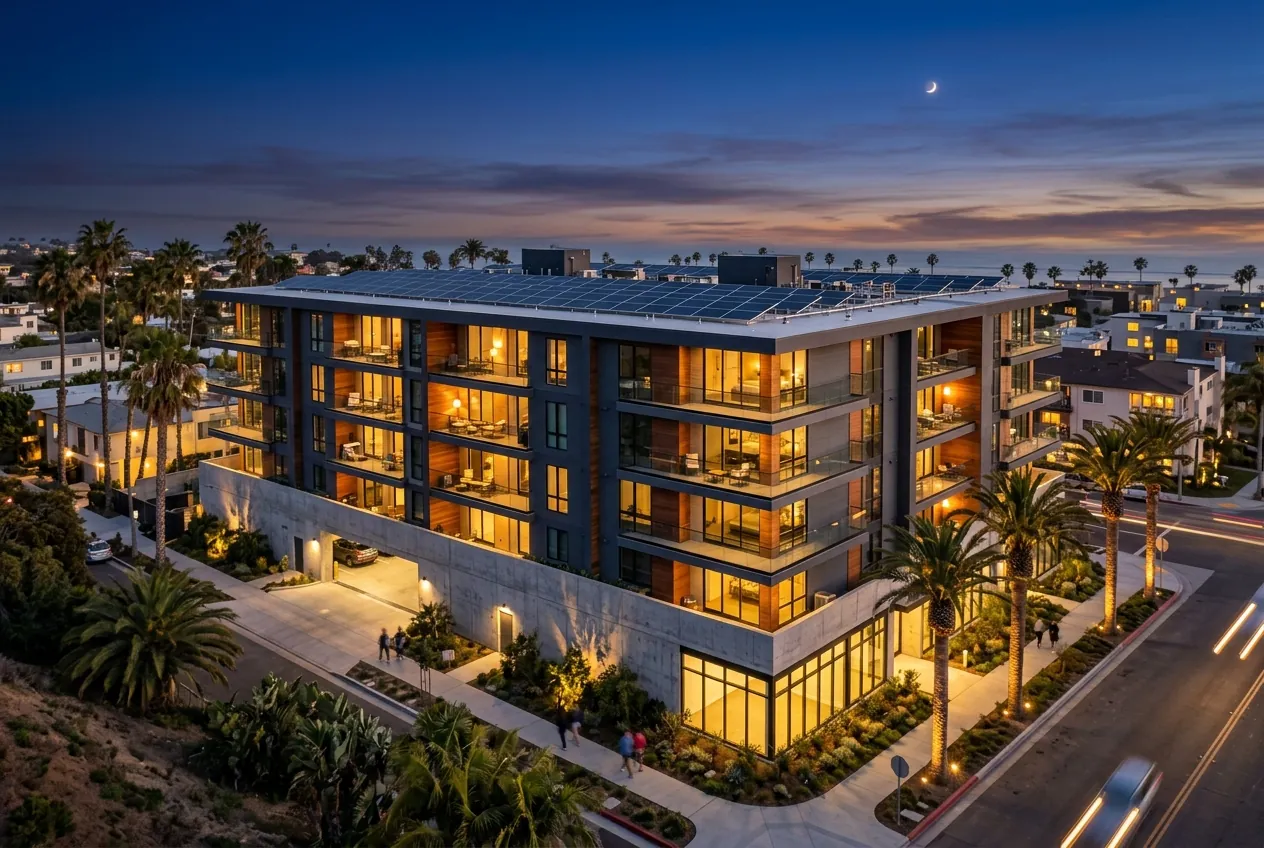
Student housing is dense, master-metered, and built against an immovable deadline: move-in day. That makes it one of the clearest cases for designing solar into the project early. The array has to fit a roof crowded with mechanical equipment, the battery has to be sized and sited, and the whole scope has to be inspected and signed off before the first lease starts.
Eventure's Role
Eventure works with student housing developers, university partners, and general contractors to deliver code-compliant solar and storage on buildings that often exceed four stories and therefore carry a battery requirement.
We bring solar into the project at schematic design, size the Energy Code requirement, coordinate the roof, structure, electrical rooms, and battery location with your architect and engineers, and carry the system through permitting, utility interconnection, inspection, commissioning, and closeout.
Title 24 treatment
Student housing is a multifamily occupancy under the Energy Code. Buildings of four or more habitable stories follow Sections 170.2(g) and 170.2(h), which require PV and a battery sized to the PV system; low-rise buildings follow Section 170.2(f).
Design Considerations
What is different about student housing.
- High-rise multifamily provisionsMost purpose-built student housing is four or more habitable stories, which triggers the high-rise multifamily PV requirement and the companion battery requirement. Both are sized from the building, not negotiated at the end.
- Master-metered load profileStudent communities usually run on a master meter with heavy evening and overnight loads. Storage sized beyond the code minimum can shift daytime production into those hours and reduce demand charges.
- Roofs built for mechanical, not solarDense unit plans push condensers, exhaust fans, and elevator machine rooms onto the roof. We coordinate equipment placement with the mechanical engineer so the required array area survives.
- Fixed opening dateUtility interconnection and final inspection have their own timelines. We file early and sequence inspections so solar is never the reason the building misses the semester.
Keep Solar Off the Critical Path
Don't let solar be the last thing standing between your project and its Certificate of Occupancy.
On student housing projects, as on every California building, the Energy Code requirement, the fire authority's review of the battery, the utility's interconnection timeline, and the building's final inspection all depend on the solar scope being designed, permitted, installed, and documented in sequence. We treat it as a scheduled trade from day one.
Solar and the Certificate of Occupancy
Questions
Student Housing solar, answered.
Can solar on student housing be delivered by move-in?
Yes, when it is part of the schedule from the beginning. The long-lead items are the utility interconnection application, equipment procurement, and inspection sequencing, all of which we start during construction documents rather than after framing.
Does university involvement change the requirements?
Public university projects may fall under state permitting processes and procurement rules, and prevailing wage typically applies. The Energy Code requirements for the building itself do not change.
Related
More residential & multifamily building types.
All residential & multifamily · All building types · Where we work
Discuss Your Project
Planning student housing in California?
Send us the drawings at any stage. We will size the Title 24 requirement, review the roof and electrical approach, and map the path to a Certificate of Occupancy that does not wait on solar.